> For the complete documentation index, see [llms.txt](https://docs.opendatablend.io/llms.txt). Markdown versions of documentation pages are available by appending `.md` to page URLs; this page is available as [Markdown](https://docs.opendatablend.io/open-data-blend-datasets/dataset-snapshots.md).
# Dataset Versions
## Dataset Immutability
Changes to Open Data Blend Datasets are always published as new Dataset Versions. Once a dataset version has been created, it remains unchanged. It is immutable.
Every data file change is versioned. This means that all data file updates are reflected through new data file versions, and new data file versions result in new dataset versions.
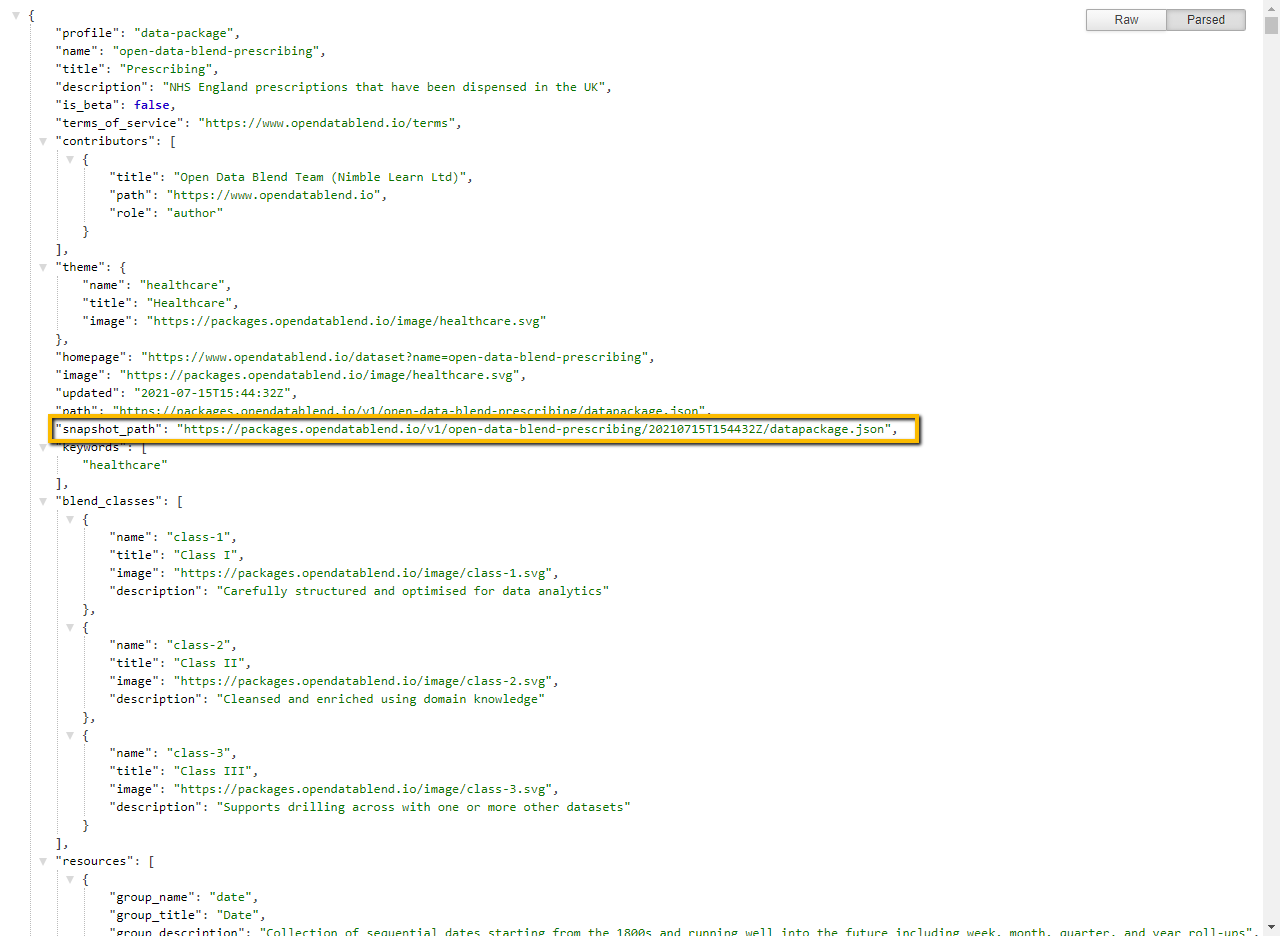
The URLs for data files always point to a specific data file version. This allows you to share these links knowing that they will always download the same data. The dataset version URLs are currently only surfaced through the [Open Data Blend Dataset API](/open-data-blend-datasets/dataset-api.md) and are visible in the `snapshot_path` property.
#### Example of the Snapshot Path for a Dataset
```javascript
{
"profile": "data-package",
"name": "open-data-blend-prescribing",
"title": "Prescribing",
"description": "NHS England prescriptions that have been dispensed in the UK",
...
"snapshot_path": "https://packages.opendatablend.io/v1/open-data-blend-prescribing/20210715T154432Z/datapackage.json",
...
}
```
{% hint style="info" %}
The [Open Data Blend Datasets page](https://www.opendatablend.io/datasets) and [Open Data Blend Catalogue](https://packages.opendatablend.io/v1) endpoint always point to the latest versions of datasets.
{% endhint %}
## Reproducible Analysis and Research
A pleasant side-effect of Dataset Immutability is that you can produce analysis or research using an Open Data Blend Dataset knowing that others can reproduce the same result at a later point in time.
Bundling the data with the analysis or research output isn't always practical, especially when the data files are very large. If you are using the Open Data Blend Dataset UI, you can do the following to get the dataset and data file version URLs:
Click the 'Get metadata' button on the Dataset page.

Then save the Open Data Blend Dataset API response (datapackage.json).
Note that the versioned URL value can be seen in the `snapshot_path` property.
{% hint style="info" %}
The`snapshot_path`property value is like a permalink but for Open Data Blend Datasets. Data file URLs always point to a specific version.
{% endhint %}
If you are using the Open Data Blend Dataset API, simply make a dataset request as usual and write-down the response to a long-term data store for future reference.
{% hint style="info" %}
Dataset versions will remain available for at least **24 months** from the date they are superseded. We strongly recommend that you download and keep a local copy of any dataset versions and data file(s) where you need to guarantee that your analysis or research remains reproducible beyond this.
{% endhint %}
---
# Agent Instructions
This documentation is published with GitBook. GitBook is the documentation platform designed so that both humans and AI agents can read, navigate, and reason over technical content effectively. Learn more at gitbook.com.
## Querying This Documentation
If you need additional information that is not directly available in this page, you can query the documentation by asking a question.
Perform an HTTP GET request on the following URL with the `ask` and `goal` query parameters:
```
GET https://docs.opendatablend.io/open-data-blend-datasets/dataset-snapshots.md?ask=&goal=
```
`ask` is the immediate question: it should be specific, self-contained, and written in natural language.
`goal` is what the user is ultimately trying to achieve, the reason they need the answer. Sharing it helps GitBook give you a better, more relevant answer. A goal is most helpful when it describes the outcome the user wants rather than restating the question. For example, with `ask=how do I create an API token`, a goal like `automate deployments from our CI pipeline` lets GitBook tailor the answer to that use case.
The response will contain a direct answer to the question and relevant excerpts and sources from the documentation.
Use this mechanism when the answer is not explicitly present in the current page, you need clarification or additional context, or you want to retrieve related documentation sections.